I thought you'd like to see something a bit different today. I don't normally accept commissions but when my son asked if I could knit bride and groom bees for his friends' wedding cake, I couldn't resist the challenge. It was actually a celebration of their wedding which had to be cancelled last year because of Covid restrictions. They got married in a registry office instead and have only just been able to mark the occasion with friends and family.
Why bees? I don't really know, other than they like bees. The theme of the wedding was 'Alice in Wonderland' so it could really have been any creatures. I'm quite glad they didn't want a pair of Cheshire Cats.
Designing the bodies of the bees was quite straightforward, although it was a bit tricky trying to keep the small enough. The real problems came when trying to give them antennae and legs. A combination of pipe cleaners and thread wrapped wire did the trick though.
For the wings I used more wire, wrapped with cream yarn. So far, so good. Then I had to turn them into a bride and groom.
For the groom I just added a purple felt tie (somehow, this photo looks unseemly) ...
But oh, that veil for the bride ... I could only find one piece of lace and it was too big, too floppy and looked ridiculous. Fitting a veil on something with wings is hard. In the end, I starched the lace and pressed it into folds give it a bit of shape and then gathered the head end tightly and sewed on some tiny pearl beading. I thought the little artificial flowers made it look more like a veil and less like a bit of old net curtain.
I had the bees finished about a week before the wedding and they were very pleased with them. Here's a photo of the bees on the cake. Not a very good photo - taken by Jack on his phone in poor light conditions - but you can see them.
All the decorations on the cake, except the bottom log and the bees, were made out of icing. Isn't that amazing? Even the cup and saucer which look just like china.
Here's wishing Ian and Tori a long and happy life together.
Let me start by introducing you to Aunty Ivy. She was actually my Great-Aunt and she was born in 1899. Ivy was the third child of Annie and George Cannons and their first daughter. They would have eight children all together, six of whom survived infancy. Here is Ivy at the age of 13 with two of her younger sisters.
Eva, seated, was 8 and the little one is four year old Ada. I know their ages when this photograph was taken as their mother had written them on the back but I also have that most useful record for all family historians - the family bible.
It's big, very heavy and has the family births, marriages and deaths recorded at the front. Here is Ivy, between the two babies who died. At the top of the list is her brother George and the last entry on the page is for Eva who was born in 1903.
Over the page are the last three children: Ada, John (always called Jack) and Ida, born in 1908, 1911 and 1915 respectively.
You've seen Eva and Ada already; here is George with his baby brother Jack in a photograph taken when George was 15 and Jack six months. Jack's middle name of Noel was given to him because he was born on Christmas Day.
Like the picture of the three sisters, this is a typical formal family photograph of the time. This photo of the youngest child, my Grandmother Ida, is a bit more relaxed.
So, that's Ivy and her brothers and sisters. Their births, marriages and deaths are in the bible and then there we also have a few photographs of them as children and of some of their marriages. Here is Aunty Ivy on her wedding day in 1924.
All but one of Ivy's siblings are in this photo; George was meant to be the Best Man but didn't turn up ... one day I'll tell you the long and mysterious story of Uncle George. Anyway, I think that's Eva standing next to Ivy and Ada at the other end of the same row. The boy in front of her is Jack and the little girl in the middle is Ida.
In the early twentieth century photographs were only taken to mark special occasions so for snapshots of daily life we have to look elsewhere. In my case, this is a huge collection of family postcards dating from 1904 to the present. My Great-Grandmother Annie collected them for the pictures but now we're just as interested in the writing on the back. In a time before telephones, postcards were often used to tell someone which train you'd be arriving on for a visit or that you'd got home safely afterwards. There are lots of the "hoping this finds you as it leaves me" variety that don't tell us much.
There are exceptions though ... this one from 1905 has always intrigued me.
The Edie who didn't want anyone to know about her marriage was one of my Great-Grandmother's sisters. Why the secrecy? The couple's first child wasn't born until 1907 so it wasn't a hasty wedding. Whatever the reason, Edie and George went on to have seven children and were together until George's death in 1940.
Then there's this one from Ivy's brother George (yes, him again).
Written when he was nearly 16 and (I think) working on the railways, George's message to his mother is intriguing. What does "look out for a surprise don't say I didn't warn you" mean? It could be anything from a new haircut to ... well, I don't know what. In the top left corner he's put "Don't worry" which is no help at all. Over a hundred years later, we still don't know what the surprise was.
I mustn't keep getting distracted; this story is meant to be about Aunty Ivy. In 1907 one of Ivy's aunts took her back with them to London for a visit and sent a postcard to her mother to let her know how she was getting on.
It looks like eight year old Ivy was enjoying herself. The upside down postcript at the top of the card reads "Ivy says tell Mother I have not cried. I like being in London".
Like all her sisters except the youngest, Ivy went into service as a young girl, as her mother had before her. This would have meant living in the house of her employer which is why we have various postcards home from her, often addressed to her little sisters. There is this one to Eva wishing her a Happy 11th Birthday in 1914 ...
... and this one to Ada a year later ...
Oh the superiority of the older sister "I expect you think you are a big girl now you are seven year old". I wonder what the knitting was that's mentioned in this next one, again to Eva.
There are also several postcards where the picture is related to the war (World War One, 1914 - 1918). Here is Ivy writing to her father in 1915.
Luckily, George who was now in his forties didn't join the army. He would have been too old when conscription was introduced the following year and I think that his job on the railway would probably have counted as a reserved occupation anyway.
The next card is to Ivy's little brother Jack, not a picture postcard for his album but another one referencing the war.
This next one was a novelty postcard produced with various town names on during the war; Ivy's family were living in Wimborne, Dorset at the time but they did settle in Andover in the 1920s. This card suggests that they already knew the town, perhaps through their father's work on the railway.
When you opened the flap, all you could see was an expanse of solid black which was what it was to be hoped the town would look like in the event of a Zeppelin raid .
This novelty card leads me - finally - to the lobster. It's 1928 and Ivy and her husband Reg are on holiday in Littlehampton. Open the flap and the lobster reveals a concertina of black and white images of the seaside town.
Very nice too, not what you'd call a chatty card (the Kemps are family cousins) but I expect Ivy's younger sister Ida enjoyed it. But now, nearly a hundred year's later, Aunty Ivy's lobster postcard has got a new lease of life.
Yes, that's right, it's the lobster from the postcard, now gracing a London bus stop. And here it is again ..
This is the window of The Postal Musem in London where my daughter works as one of the archivists and all those lobsters are on posters advertising their current exhibition marking 151 years of the British postcard. 151 years rather than 150 as the original exhibition was planned for 2020 but had to be postponed because of the pandemic.
Wish You Were Here runs until the end of the year and features postcards from the past, exploring themes from romance and war to the Great British seaside holiday. For those unable to visit the exhibition in person (which of course includes me), this video gives you a tour of the highlights. Some of the postcards you can see in the seaside section are from our collection.
The Postal Museum Blog is a fascinating read too for those interested in social history. Amongst the interesting human stories from within their collections are several posts directly relating to this exhibition. Postcards from the Front looks at the cards sent by soldier Harry Brown to his mother during the First World War, while Seaside Postcards is an entertaining read. I also enjoyed Creating an exhibition in the middle of a pandemic; putting an exhibition on is much more than just sticking a few things in a case.
Another exciting aspect of the exhibition from a purely personal point of view was the fact that some of our postcards were used to create items to sell in the museum shop. In this video the artist Emily May talks about turning some of the postcards into watercolours which were then used to created things to sell in the museum shop to accompany the exhibition.
Obviously, I had to buy a few things ...
I'm particularly pleased with the tea towel which I shall probably use to make a bag.
In this close up, I can see several of our postcards ...
As well as the lobster, the blue bus and the donkey are ours. Can you spot them?
I thought it would be nice to talk about a few of our other postcards that are in the museum and the people behind them. I didn't have photos of these ones so I'm grateful to The Postal Museum for permission to use theirs. First of all, some gentle seaside humour.
This one was sent by Uncle Jack, who we last saw as a small boy at Ivy's wedding, to my Mum and Dad in September 1956. This is what he wrote on the back ...
The Saturday referred to was the day of Ann and David's wedding and it was indeed windy. This is probably my favourite of their wedding photos.
A year later and my brother Stephen was a new baby and he and Mum and Dad were staying at Mum's parents while they were on holiday in Dorset. I suspect they were looking after the garden and the pigeons (Grandad kept racing pigeons for many years). This is the postcard sent to them by Ida.
The writing on the back manages to include baby Stephen's weight, a roast goose and blue jellyfish - can't you fit a lot on a postcard?
And here we have a photo of Stephen as a baby to confirm that he was indeed putting on weight well, although he doesn't look very happy about it.
We have a whole series of postcards sent to Stephen by his Granny, some of which bear the marks of having been chewed on. He particularly liked ones with a squeaker in but, sadly, these couldn't be used in the exhibition. There were other novelty cards to choose from though. She chose this one a few years later which opens out in the middle in the same way as the lobster card does.
Here is Stephen with his Granny about this time. He seems to have slimmed down a bit.
In 1961 Ida was on holiday in Weymouth and sent Stephen this postcard.
By turning the wheel at the top, more pictures could be seen. Stephen had obviously moved on from just chewing the cards. Here's the writing on the back ...
... and yes, Frances is me. I was born in 1960. Here I am in my pram with Stephen considering me. He looks quite pleased - not sure about me.
I love the sentiment on the front of this next card, again from my Granny.
They were staying at Butlins Holiday Camp and, having brought up four children, including for several years on her own during the war, she definitely appreciated a bit of time off.
One more of our postcards from the exhibition, this one sent to me in 1968.
Suzanne and Carole are our cousins, a few years younger than me. Here we are in our garden at Longstock at around that time (I'm the one in the green dress).
Before I go, I've got one more picture to show you. This is Aunty Ivy's Golden Wedding Anniversary in 1975 and quite a few of the people I've been talking about are there, as they were fifty years before. Apart from Ivy and Reg obviously, the woman next to Reg (with her arms crossed) is Eva and the man with the cigarette in his mouth at the end of the row is Jack. Next to him, wearing glasses, is Ida. I think Ada must be there too but I'm not sure which one she is.
As long standing (and long suffering?) readers of my blog will know, before Long Covid moved in to stay I used to go for a lot of country walks. Now that breathing is something that has to be monitored and handled with care, this is obviously not possible. What I have been doing though is a daily walk, building it up very slowly.
I started in late January by walking round the block, the same route every day - a distance of 0.5 miles. The idea is that doing the same route gives me less decisions to make (decisions make me tired) and also gives me landmarks to measure how I'm doing.
So, many months later, I'm now up to one mile and the walk now extends to take in the park which is nice.
Things I have learnt:
Walk slowly. I'm naturally a bustler but, if I walk too quickly, I run out of breath.
Walking on grass (or in snow) makes it much harder to breathe.
It's easier to walk earlier in the day when I'm not so tired. This only dawned on me last week when I ran out of breath and only just made it home.
When I run out of breath and start to feel dizzy, I need to stop for five minutes ... even if I'm nearly home (see point 3)!
I am now an expert on the local front gardens, who has what plants and which houses have dogs or cats. You can find something interesting on even the shortest walk.
But ... it's not countryside. Nor is this but it's a lot more like it ...
This is the view from the slightly soggy bench where Jack, Rose and I had a picnic last weekend. This is Spiceball Park which is in the middle of Banbury, right next to the canal and it's the furthest I've walked from home. It was so nice to see all that green and the trees (and my flask of tea was good too). After the picnic we had a bit of a walk round by the river and back along the canal path.
By this point, we realised that I'd probably done a bit too much so Rose and I sat on a bench for another rest while Jack found me a conker. The walk home was very slow and I ended up leaning on Rose before we got there. But - I'd walked two and a half miles all together. It's not something I could do regularly but it did me good. I was wondering why my face felt different and I realised it was because I kept smiling.
Today I thought I'd introduce you to two friends, one old and one new. First of all, meet Marmaduke.
As you can see, Marmaduke is a mouse troll with orange fur and he's a very old friend that I thought I'd lost. He turned up in a box of various small toys when we were sorting through a cupboard last weekend and, after a clean up, he really looks good, considering he's over fifty years old. I'd forgotten his name but, as soon as I picked him up, it came back to me. I suspect I named him after Marmaduke Stanley, the cook / housekeeper in one of my favourite books, The Little White Horse by Elizabeth Goudge.
Marmaduke is special because he brings back a nice memory of Mum and me having 'spendies' on a shopping trip when I was little. I remember being very excited at being able to choose things, just like that. This is where we went - Andover High Street in the 1960s.
I have no idea what Mum got for herself but I do remember choosing a red bouncy ball and then spotting Marmaduke. He was in a clear plastic box with a hole in so you could feel the fur and I can still remember how soft he felt; I thought I'd never seen anything so wonderful. Mum and I would have fun shopping together for many years but this was the first time that I remember.
Moving on, I bet you're wondering what sort of toy Stanley is going to turn out to be. Meet Stanley the Vice ...
Stanley the Vice - isn't that a great name? He only arrived yesterday and is already proving to be a very useful sort of friend. And no, he didn't come with the eyes already fitted; I have to say, I think the manufacturers are missing a trick there. This is what he was helping me with this morning ...
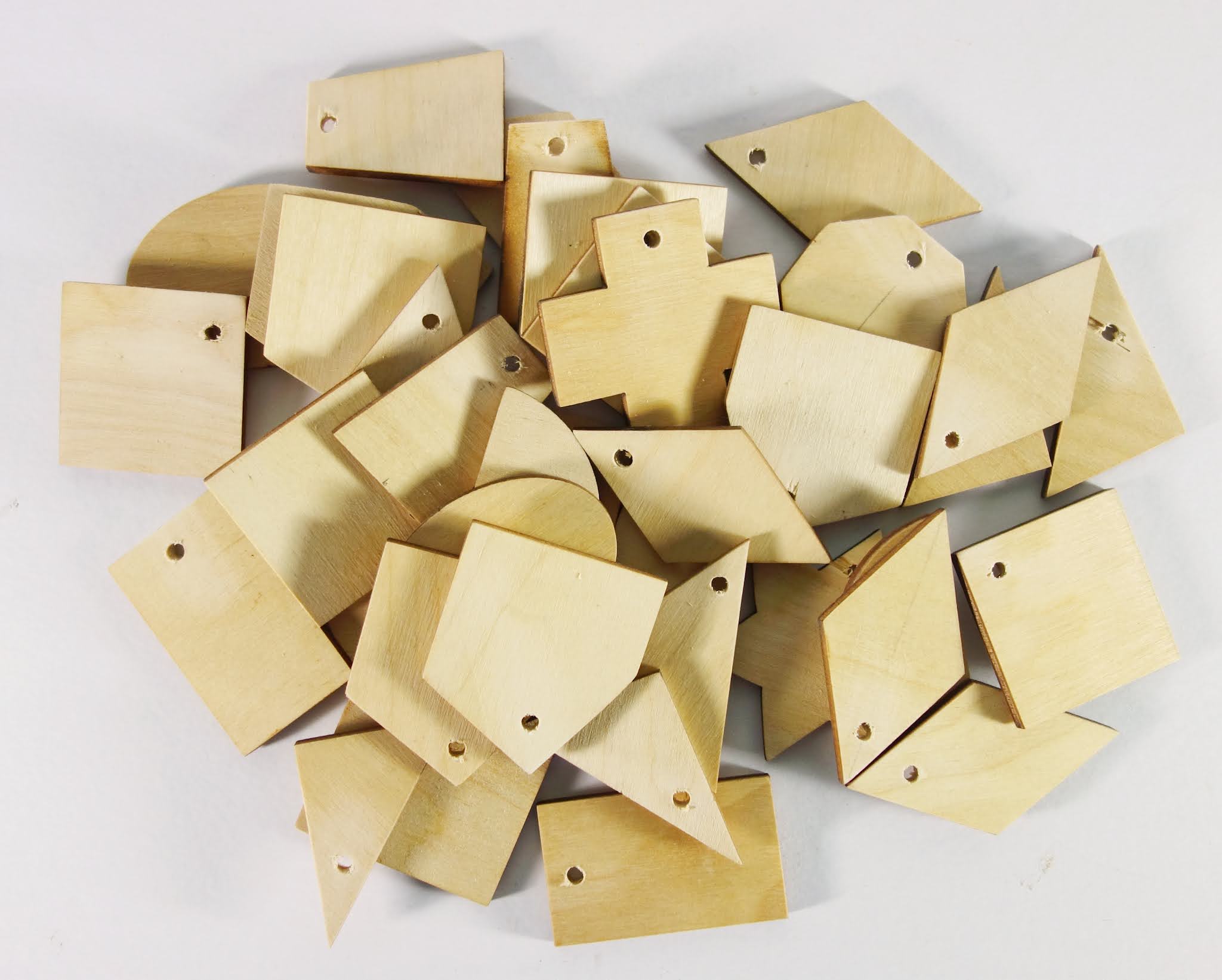
... drilling holes in lots of little wooden shapes. My daughter Rose and I bought a big bag of wooden shapes for £1 at Orinoco, our new scrap shop. It's full of donated and recycled craft supplies and yes, it's named after the Womble of the same name. All together now:
'Underground, overground, wombling free,
The Wombles of Wimbledon Common are we.
Making good use of the things that we find,Things that the everyday folk leave behind.'
I think these wooden shapes will make great gift tags or decorations, they just needed holes to hang them up by - hence Stanley's involvement.
I predict a happy future for Stanley and me. I think he's going to be very useful for all sorts of crafts.
Before I go, look what else I bought from Orinoco.
Don't get too excited - they're empty (although they do sell old knitting patterns too). These three files would have come from a yarn shop and cost me £1. I'm planning to fill them with some of my collection of old knitting patterns. Isn't that a fitting use for them? In fact, I may go and do that now.