Sunday, 18 February 2018

Patterns from the Past

I've collected old knitting patterns for years. They're a good way to combine a love of social history and craft, as well as still being ridiculously cheap. Only a few days ago I added two beautiful baby patterns to my collection which cost me all of 50p. Charity shops are the best places to find vintage patterns; the really old ones are normally buried at the bottom of a box of more modern patterns and are often much cheaper than the new ones.

Anyway, I thought it would be a good idea to take photos of some of my collections and share them here. Most of them are in these three old suitcases (apologies for the poor quality photograph - they're in a dark corner).


As you can see, they're being guarded by my knitted Teddy Bear and Ferdinand the wooden sheep. He was carved for me by my daughter; he has a lamb but it's fallen down the back of the bookcase and I haven't got round to moving everything to rescue it yet. By the way, that's me in the photo on top of the suitcases, aged about six with our lovely dog Buster.

It turns out that it takes a long time sorting through and photographing old knitting patterns so I think this is going to have to be the first of a series of posts. Let's open the smallest suitcase first.


On the top are my Stitchcraft booklets. These were published by Patons & Baldwins and I should think they date from the 1950s. They are all collections of patterns for babies and children.


Aren't the covers wonderful? Just look at the baby in the pink dress, beaming happily. And what about the two children on the cover of the Nursery Knitting Book?


Children still enjoy blowing bubbles but they don't use proper little pipes like those nowadays. Inside this book, there's a lovely pattern for Norwegian style hat, scarf, glove and mittens which would look just as good today.


Here are some more P&B booklets, including some of the 'First Woollies' series and some 'Beehive Baby Books'.


These two patterns from the red Beehive Baby Book (SC14, price 1/6) show what would have been old and new style patterns at the time of publication.


First there's a pram blanket knitted with Patons Double Quick Knitting and edged with ribbon. Most of the other patterns in the book use thin baby wool, 2, 3 or 4 ply, so this was definitely a bit different. Worked in a cable stitch pattern, it would have been nice and warm.

The baby on the other page is wearing a ribbed vest and pilch, described as a 'Basic for Babies' set. This is much more traditional knitting, worked in thin yarn. In case you're wondering, a pilch was a knitted cover to go over the top of the nappy - patterns for these were as common as those for vests and booties.

A couple more Stitchcraft booklets ...


'Schooldays' and - with apologies to all the men who knit - 'He-knits that she knits'. The back covers of these two are good as well.


This is the back of 'Schooldays'. I know this is what we would now think of as a teenager dressed as a middle aged woman but the clothes themselves are beautifully designed. Here's the back of 'He-knits' ...


Nothing quite like the smile of someone who knows he's got someone to knit his jumpers for him. The only surprising thing about this picture is that neither of them is holding a pipe. Men with pipes feature a lot in old knitting patterns - "I may be a knitwear model but look, I smoke a pipe like a real man". 

Underneath the booklets are two big piles of mostly single knitting patterns. They're all either Bestway or Weldons patterns.


These are small patterns, about 8 x 5" or so, the older ones in black & white, the more recent ones in colour. I think they're all pre - decimal which dates them to before 1971. What shall we start with? I think the Bestway Booklets at the top of the picture.


'Gloves and Mitts for the Family' has patterns for everyone and every season. Those were the days when a lady never went out without her gloves, even if they were lacy ones for warm days.


The booklet on the right, 'Fair Isle Motifs for Childrens' Woollies' comes complete with charts ...


... while you'll be glad to see that the boys in 'Boys' Knitwear' aren't letting standards slip. They may be hanging round on a street corner, but they're still wearing their ties.


The individual Bestway patterns are for everyone and every occasion. Naturally, there are lots of baby patterns. 


I especially like the one with the baby in pink, I think it's the combination of colours - pink, turquoise, lemon and lime green - I'd like to knit something with all those colours in. There are also a few patterns for bonnets and booties.


When my first baby was born in the 1980s baby bonnets were still called 'helmets' if they were for baby boys - so much more macho. There are lots of cardigans and slipovers or waistcoats in the childrens's patterns; most of the models don't exactly looked relaxed.


But when it comes to artificiality, you've got to go a long way to beat some of the women on the Bestway patterns.


The one in yellow is definitely smiling through gritted teeth. The hairstyles are pretty tortuous too. As for the men ... as promised, a man with a pipe.


You can see the styling starting to relax a bit between these two family patterns.


The man and boy in the pattern on the right may still be wearing their ties but at least their jumpers are a bit more casual. This is one of the few patterns to use chunky yarn which would have seemed very thick to a generation of knitters used to working with thin 4 ply yarn.

There are a lot of old sock patterns around, like this one for schoolboy socks. I think the stripes on the socks would have been worked in school uniform colours. 


The other pattern above is for bedsocks, sized for children and adults and in various styles. I think the knee length ones are probably tube socks, knitted with a spiral rib pattern that means they don't need any heel shaping. My old house is always cold, I could do with a pair of those ...


There are several patterns for gloves and mittens - can you spot another pipe? I think the mittens on the right are great (slip stitch, by the look of it). You could knit those for a child now and they'd look just as good as when they were first published.

What else is there in the Bestway pile? Oh yes, a few elegant ladies in black and white.
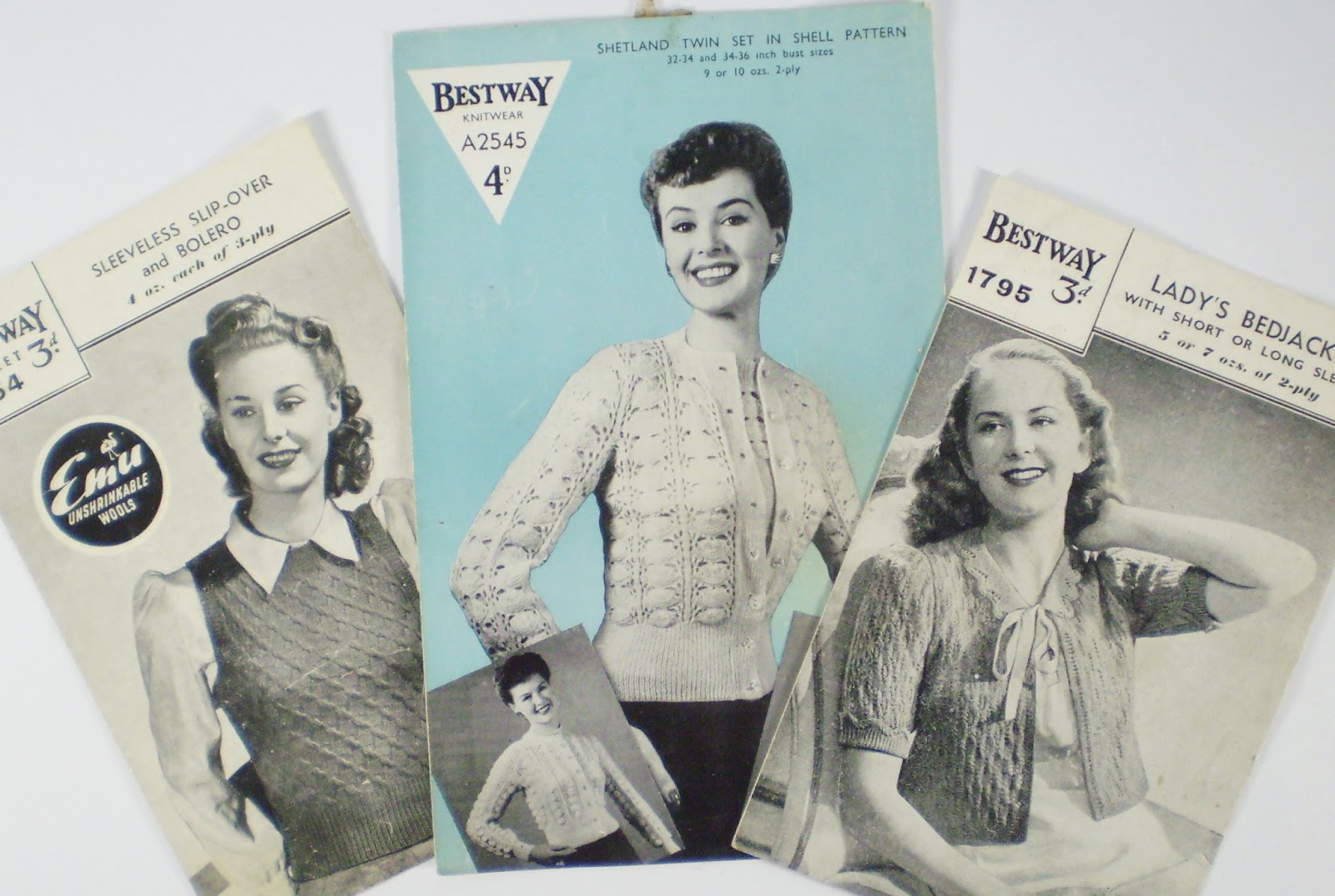

I do like a nice bedjacket pattern. One day I'm going to knit a bedjacket. If you live in a warmer house than mine you could always wear one over a summer dress on cool evenings.

This is one of my favourite patterns.


It's an outfit for dolls in three sizes - 12, 14 and 16". I think this would fit my original Tiny Tears who I've had for over 50 years, not to mention the original Teeny Tiny Tears that I haven't got but hope to find one day.

There are several patterns for string bags and a few collections of tea cosies. I do like tea cosies.

And finally, I was struck by these two patterns. I wonder if that's the same little girl and, if so, where she is now?


I've probably got fewer Weldons patterns than Bestways but I think they're my favourites. There's something about their design that I absolutely love. Just look at these womens' patterns.

These models look alive in a way that the Bestway ones rarely do. And isn't that green jacket wonderful? Or how about these hats?


I think all of these look stylish and appealing. Do you think the woman in the Fair Isle set is trying to explain colour photography to her Black & White colleagues? If so, I'm not sure the one in the fuzzy bonnet is quite getting it.

My Weldons baby patterns look more dated but the designs are still interesting. Batwing baby cardigans anyone? I used to knit those for babies as these were easy to get their arms in and out of.

The children's patterns are lovely too. 


That 'Windcheater Pullover' at the top looks very practical (I remember when a certain style of jacket was called a Windcheater - wonderful name). And just look at the little girl in the yellow cardigan, now that's what I call a smile.

I suppose it's in the nature of glove and sock patterns that they don't change much ...


... and you'll be relieved to see that the men are still wearing their ties and holding their pipes.


There are just two more Weldons patterns to show you and these are amongst my favourites. First there's this penguin tea cosy. What do you mean, you don't feel the need for a penguin tea cosy?


And then there's this ...


Yes, that's right, it's called 'Television Knitting, Designed to Knit while you Watch'. There are four patterns: for a bedjacket, a zip up jumper, a short sleeved jumper and a blanket. Just in case you didn't get the point, each picture is framed by a television screen. Now I know I'm laughing at this but look at that blanket. Is it just me or is it very like my Pathways blanket? They say there's nothing new under the sun.

I bet you're thinking we've got to the bottom of that suitcase now but you don't get off that lightly. There's one more pile to show you before you're allowed to go and make a cup of tea. 

This is my collection of Woolcraft magazines, a publication which went through many editions during the 20th century. My earliest copy is the 8th edition which dates from the early 1930s and my most recent is the 17th edition from 1962.


Inside the 8th edition I found a torn out page from an engagements calendar for July 1937 on which someone had written a pattern for a knitted skirt.


It's 31" long and sized to fit someone with 40 - 41" hips. It's called 'Ribbed Skirt' and is knitted with 16 oz 4 ply Excelsior wool and a number 9 circular needle. A circular needle in 1937? I thought they were much more recent than that. Wouldn't it be fun to knit this and see yow it worked out? 440 stitches though ...

For many years, all editions of Woolcrafts had a full page illustration for each section. Here's the one for the baby patterns from this one.


By 1962, those illustrations had been replaced with a more modern look.


But my copy of the 16th edition of 1956 still looks quite like the early editions.


Funnily enough though, my 1962 Woolcraft does have something in common with my edition from 30 years earlier ...


Not a knitting pattern this time but the details of the various pullovers knitted. David's was in lemon 3 ply (maybe that's the wool used to tie the page to the book), Simon and Andrew's were in maroon and Ian and Katie's were in gold. The knitter has made notes of the number of stitches for each part and the individual measurements. I love finding things like this.

While I think about it, I found this book a useful source for information about the Woolcraft magazines. In fact, it's pretty much essential reading for anyone interested in the story of knitting.


This is the late Richard Rutt's A History of Hand Knitting, first published in 1987 and now sadly out of print. If you can find a secondhand copy, do buy it - it's an absolutely brilliant book. As well as masses of interesting historical detail about knitting, it's worth buying just for the appendices alone which include a list of publication dates for the Victorian 'Weldon's Practical Knitter' (another one of my collections) and a copy of the earliest known knitting pattern (it's a sock pattern in case you were wondering).

If you want to read more about old knitting patterns while you drink that cup of tea (yes, I've nearly finished), I can recommend the blog Knitting Now and Then where Barbara writes interestingly about all aspects of historical knitting. I also found a flickr album of Bestway patterns complied by Lucy of the blog 1940s Style For You. You can browse through it here. I'm sure there are lots more resources out there; if you know of any others, do let me know by leaving a comment below.

And now I'd better put all those patterns away again.

Wednesday, 14 February 2018

Hearts

I don't really 'do' Valentine's Day. Well, to be truthful, I don't do it at all. But I know lots of people do so, over the years, I've designed various heart patterns. I may not like the day but hearts are quite fun to design and another good chance to play with colours.

My first attempt at a heart pattern was eight years ago (Blimey, that seems a long time - sometimes I forget how long I've been at this lark. Ten years this summer, should you be wondering). Anyway, Folk Hearts are simple knitted hearts with a crochet edging.


That's right, crochet in a knitting pattern. I never mix the two now; there are too many people out there who only knit or crochet, not both and I've found a little bit of another craft puts them off. But I didn't know that then and I think the crochet edges look nice. They also hide any uneven edges which is always good. Notice the buttons I've used to decorate these simple hearts. I am very partial to buttons and will use them to decorate anything that stays still long enough. As we shall see ...

A couple of years later and my heart making skills had developed a bit to allow for a knitted border that's part of the main knitting. I'm still pleased with  Framed Hearts; they're simple and clean looking and I really like that garter stitch frame.


I developed the frame idea a bit further with my Button Quilt pattern which uses leftover sock yarn to knit little round shapes in a square frame that can be sewn together.


You know, I really like this pattern. I must fish my quilt out and add some more buttons to it. I've still got an awful lot of odds and ends of sock yarn lying about.

But of course I couldn't resist decorating the framed hearts a bit. There were buttons and some embroidery ... oh, and a bit of felt too.


There are an awful lot of crochet heart patterns out there so I haven't done much with crochet. It's easier to crochet a heart than to knit one because you can work them in the round, rather than having to knit several pieces and then sew them together.  I did sneak a few little hearts into this pattern though.  


Hearts etc started out as a pattern for little bowls but then there were padded hearts, layered hearts - oh, and a few little, decorated mats too. Some of us just never know when to stop.


It wasn't  until last year that I worked out a way of knitting hearts all in one piece. Hearts in a Hurry are knitted in garter stitch (possibly my favourite stitch of all) and they're very quick to knit. I really enjoyed designing these and had a lot of fun arranging them for photos.


Aren't those colours lovely? I think my favourite patterns are always those with lots of bright colours like this. I'd like to say that I wasn't tempted to add anything to these hearts but that wouldn't quite be true.


I haven't designed any more hearts since these, although a few did sneak into last year's February Mini Quilt,


Maybe it's about time I did another hearts design? In the meantime, I'd love to hear if you've knitted (or crocheted) any of these patterns and what you used them for. 

Oh, and Happy Valentine's Day.

Wednesday, 7 February 2018

A little bit of everything

Today was a working day and, with so many projects on the go at once, I decided to do a little bit of everything, sorting them out as I went. First of all, I finally cut out lots of small felt circles and started sewing them to the back of my crochet Spirograph circles that I showed you a while ago.


There are rather a lot of them as you can see. I've made 24 (so far) with eight different patterns. As the backs are messy I'm going to back each of them with felt. This also makes the circles lie flat.  Then I'm going to string them together in various combinations ... I think. What puts me off simple sewing projects like this isn't the actual sewing but having to collect together all the bits and pieces; it took me ages just rooting out eight reels of thread in the right colours.  I've backed four so far so only another twenty to go. 

That big one at the bottom of the picture is an experiment with 24 holes round the edge rather than 12. I did it just for fun - I may or may not include it in the finished pattern. This project has turned out to be a lot of work and I suspect it will sink without trace when I finally publish it. Never mind, I like this sort of oddity even if nobody else does and it's been fun to do.

The next two projects could both come under the 'winter warmers' heading - mittens and legwarmers. I've knitted a pair of basic red mittens, using a broken moss stitch pattern and now I'm starting on another pair which will be a bit different. The yarn and stitch pattern are the same but the second pair will have no thumbs and the top will curl to match the relaxed shape of a hand - go on, hold your hand up and you'll see what I mean. These were inspired by Elizabeth Zimmermann's jogger's mittens in Knitting Around. Hers are sewn together at the tip; I'm hoping to shape mine with short rows.


As you can see, I've made a start on the second of my legwarmers too. These were going to be in shades of brown and gold but it looked too 1970s for me so I've used two close shades of red instead. I'm using a slip stitch pattern for these to make them extra warm (and because I love slip stitch).

I've talked about my design for a traditional leaf blanket before. Well, I've tweaked my pattern a bit so I'm happier with it. The one on the left is the original, the one on the right is the new version. What do you think?


The main difference is the eyelet section. I didn't like the original spacing so I've put them closer together and made the whole section bigger. I also made some complicated changes to the bells ... which are virtually invisible. Never mind, I know the pattern's better for them.

My original notes were full of crossings out and re-writings so I typed them up. I'm knitting the next square from the typed draft so I can check the instructions as I go.


I'm looking froward to having four squares done so that I can sew them together and see how the patterns look as part of a big block.

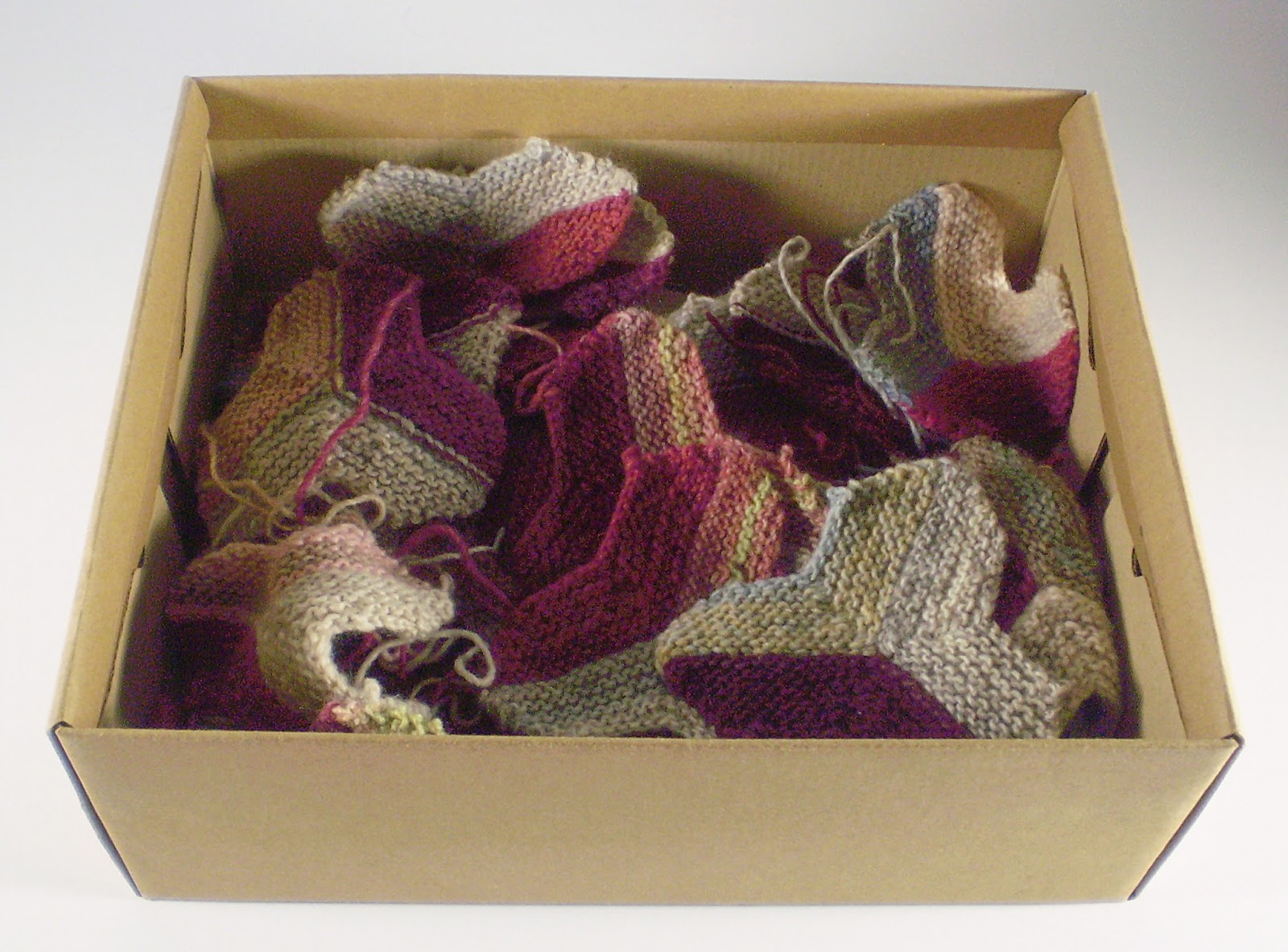
All this sorting out of projects was starting to feel good so I pulled out two blankets that I started working on last year and which have been hiding since Christmas. First there was this box ...

These are the blocks for what I'm going to call my Helicopter Blanket. This is another garter stitch design based on a Quilt block and yes, I know I haven't sewn the ends in - that's because I'm hoping to use them to sew the blocks together. Want to see what they're going to look like? Of course you do.


It's meant to look three-dimensional; I think it does if you squint at it. Each block is made up of three identical shapes, each one knitted in a different colour. You pick up stitches for the second and third of the shapes so there's no sewing. So far I've finished 33 blocks; they're not very big so I need to knit a lot more. And no, I have no idea what shape the finished blanket is going to be (or what I'm going to do about the edges). I expect it'll come to me eventually.

The other blanket project is what I call vanilla knitting. Simple garter stitch using lovely colours - the sort of thing that you can do when you're feeling a bit tired and fragile and anything else seems too difficult.


Aren't they pretty? I think the shade of King Cole Riot I'm using is called Caribbean but I may use other shades as well. Now that I've found these blanket projects, I must get on with them.

Before I go I wanted to show you the Dorset Buttons I made with a kit I got for Christmas (thank-you Pat). The kit was from Beaker Button and came with yarn, rings and instructions for five different designs.


The blue buttons on the right were made with the yarns in the kit. For the others I used various yarns from 21st Century Yarns.

Dorset Buttons were a thriving cottage industry, employing numerous families until the advent of the button making machine made their skills redundant. They're now popular with craftspeople and artists. You could use the basic technique to make giant circular wall hangings or just use the yarn you've knitted a cardigan in to make a set of perfectly matched buttons.

There's lots of wonderful stuff on the Beaker Button site, including a tutorial for the most common type of button, the Crosswheel Button. All you need is a metal or plastic ring (a curtain ring is ideal), some thin yarn or embroidery cotton and a needle. I really enjoyed making my buttons and am going to order some more rings in different sizes so that I can experiment a bit more. I fancy turning some into jewellery.

In the meantime, the basic weaving technique has found its way into another one of my projects (I'm so easily influenced).


These are knitted Mandala Stones and yes, they are in fact stones with knitted covers. My daughter says one day she'll come home for a visit and find everything has been covered with knitted cosies. I enjoyed knitting these with odds and ends of sock yarn and then added a bit of Dorset Button style weaving to each one. I'll write this up as a pattern soon - just in case anyone else feels the need for some woolly stones in their life.

Monday, 22 January 2018

Special Books

I nearly always read fiction on my Kindle nowadays as it's much easier on my eyes but I still buy real books where you need more than just the text - art books for example. Not having to worry where I'm going to find shelf room for all the fiction I read means I can indulge in these sorts of books without guilt.

For Christmas I got two such books and they're both really beautiful as well as being great to read.


The Secret Lives of Colour by Kassia St Clair is the story of 75 different colours, all with the most evocative names. Cerulean, Heliotrope, Dragon's Blood ... to name but a few. For me, heliotrope always conjures up the image of Maria Merryweather's governess Miss Heliotrope in Elizabeth Goudge's wonderful book The Little White Horse.

I was particularly taken with the story of Scheele's Green which, because of its high arsenic content was responsible for many deaths, including Napoleon in exile on Saint Helena. Or how about Scarlet which originally meant a fine leather which took strong dye so well that it became associated with this particularly bright shade of red. Scarlet has been associated with martyrdom, the military (in England) - both presumably because it was the colour of blood - but there are also numerous 'scarlet women' in literature, from the whore of Babylon to Hester Prynne in The Scarlet Letter and beyond.

This is a beautifully produced book, as befits its subject. Those little coloured dots on the cover are slightly indented and then, when you open the book, you see this ...


... colourful endpapers for a book on colour. All the colours are well indexed but each colour also has a wide band down the side of the page so you can just flick through the book, choosing a colour to read about.


Add to this some interesting articles on the science and language of colour, as well as a glossary of other interesting colours that wouldn't fit in the book and you have the perfect book on colour.

The second book, Year of Wonder by Radio 3's Clemency Burton-Hill is sub-titled 'Classical Music For Every Day' which is exactly what it gives you. For each day of the year there's a piece of music to listen to, along with a story or description of the piece chosen. For example, the music for 9th January is the Offertorio from Verdi's Requiem. This was sung by a choir of prisoners in Theresienstadt, the numbers gradually dwindling as they were deported to Auschwitz. Knowing that adds something to the experience of listening to the requiem. 

I particularly enjoyed the Adagio from Albinoni's Oboe Concerto in D minor on 17th January. I'd never even heard of him before; apparently he was the first composer to write solo oboe concertos. I'm looking forward to discovering lots more exciting music as the year goes on. This book sits well alongside the subscription to BBC Music Magazine that I bought with some Christmas money.

Again, this is a lovely book. The hardback cover feels soft, like a subtle velvet. How do they do that? It makes it a pleasure to hold and read. So, all in all, two very special books and thank-you Stephen for getting them for me.

I'll leave you with that oboe piece to listen to.


Wednesday, 17 January 2018

Woolly Plans

I had a lovely time at Bicester Wools yesterday, choosing yarn for some of the many designs I've got in my head at the moment. This year I'm trying to only work three days a week - Mondays, Wednesdays and Fridays. So far it's going well, although it's a bit strange not to be working all the time, especially in the evenings.

I do seem to have got my enthusiasm for designing back though; I've got masses of new ideas and am desperate to get to work on them. Which brings me back to my yarn shopping.


This is a selection of what I bought. The red at the back is destined to be turned into two related but not-quite-the-same mitten patterns. The brown is some more Stylecraft Special DK which, with a few other colours, will be some slip stitch legwarmers. Yes, I know it's not the 1980s, although I was very keen on legwarmers back then ... 

The variegated blue and green is a big ball of DK weight sock yarn as I thought I would work out a pattern for some thicker socks. It's freezing here as I type (even with a cat sprawled across my lap) so these seem like a good idea.

So that leaves me with two more lots of yarn. First of all, that cream at the back ... I know it doesn't look very exciting but it feels great. It's Rowan Wool Cotton which is 50% wool and 50% cotton (just in case you didn't guess from the name). The bad news is that Rowan have discontinued this yarn, the good news is that it's in the sale at Bicester Wools so I bought eight balls. Want to see what I'm going to knit with it?

Ever since I found a copy of Mary Thomas's Book of Knitting Patterns in a secondhand bookshop on a wet day in the Lake District about thirty or more years ago, I've been fascinated by the Garden Plot Square in the chapter on Medallion Knitting.


It's a traditional leaf square, knitted in fine white cotton in the 19th century and used to make a blanket or counterpane. I always thought that, one day, I'd knit a blanket like this. What with my new 'only working three days a week' thing, I found myself with a free afternoon last week so I rooted out some old cream cotton (I don't knit with white ... or black, come to that) and had a go.

Guess what? It's huge. I was using 4 ply yarn and the square came out at about 10" which, given that you'd need four to make a block, would make each block 20". I suspect that the original knitter would have used much finer cotton than mine but I didn't really want to go any thinner than my 4 ply. 

So, I decided to design my own leaf square, inspired by this one but smaller. I also changed the shaping as I didn't like the holes you got from increasing with a  yarn over at the start of rows. This is what I came up with.


That's the square knitted from the original pattern on the left and my version on the right. I've kept the leaf, albeit a bit smaller, and the welts on the first half of the square but replaced the leaves in the centre with a panel of moss stitch.  I did want to include some more motifs though so I put in a section of bells, adapted from the stitch pattern in the same Mary Thomas book. My eyelet welts at the end are again an echo of the original, just with a bit more spacing between them. My square is about 6" so four sewn together will be 12". I'm planning to knit a small blanket, four squares wide and six squares long and then add some sort of border. I'll see if  I can find the inspiration for that in the book too. 

I may make a few more changes once I start knitting with the new yarn but I'm looking forward to making a start on this. 

The rest of the yarn in the basket (the pink, blue, yellow and cream) is going to be used with some other colours of Sirdar Country Style DK that I've already got. This is a lovely yarn and I've been using it for years but recently I've become disappointed with the range of colours. Nearly all my favourites have been discontinued and what's left is rather subdued and uninspiring. 

Anyway, this is what I'm using eight of my shades of Country Style for ...


I know, crochet circles in pretty colours - so what's new? Well, if  you look closely, you'll see a ring of tiny holes on each circle; they show up on the yellow one. Those holes are there so that you can turn plain circles into something much more exciting.


Aren't they good? I've been so excited about this idea and couldn't wait to put it into practice. Many late nights (and a lot of graph paper) later, I came up with eight different designs to embroider or weave on to the circles. It's a combination of both really, mostly embroidery but you do have to do a bit of weaving to make the patterns look continuous.

I'm going to turn some into decorations and join others together to make a wall hanging or maybe a table runner. I wouldn't actually want anyone spilling tea on them though so maybe the wall's the best place for them.

And yes, in case  you're thinking those patterns remind you of something, I did have one of the original Spirograph sets as a child in the 1960s and I loved it. I've just bought myself a new set to play with; there are so many lovely pens to use with it now and they don't make holes in the paper like the old biros used to. 

That's about it for now. If you're in the area, Bicester Wools has lots of reduced yarn and some really nice fabric in the sale too so do go and have a look. I bought some more fat quarters to make bags with. Which reminds me, I really must write up that pattern ...

Tuesday, 2 January 2018

Secret Crafts

Happy New Year everyone. I hope that 2018 turns out to be a peaceful one for you all, full of yarn and other good things.

Now that all the presents have been unwrapped, I can share with you some of the things I made for other people last year. Every year I promise myself I'll make more of the presents I give and every year I run out of time. Having said that, I did quite well in 2017 as you'll see.

I've been weaving on and off for a few years now (more off than on if I'm honest). My loom is an 12" Ashford Knitters Loom  which is a small rigid heddle loom that folds up and can be stored in its own bag. I do hanker after a wider loom - perhaps a 24" Kromski Harp - but for the moment I'm happy with what I've got.

Anyway, I had a bit of a phase of weaving towards the end of last year and wove three scarves for presents.


The pink and green one was woven with a ball of variegated sock yarn and the other one used three shades of Stylecraft Carnival Chunky. For this one I used each of the three colours in turn, both in the warp and weft, which gave a nice tweedy effect I think.

The scarf I'm most pleased with though was the one I wove for my son's birthday in November. He loves bright colours so I decided to warp the loom with lots of rainbow shades. These are all odds and ends of Sirdar Country Style DK, one of the yarns I use a lot in my designs.


How's that for a colourful warp? I didn't want to swamp all that colour when I started weaving so I chose a thinner sock yarn (about 400 m / 100 g) for the weft in charcoal grey. That meant that the colours still dominate the scarf, with the grey just holding it all together.


I really enjoyed weaving this one, even if that thin warp made any missed threads very obvious (there was a fair bit of un-weaving when I got tired). Here's the finished scarf in all its glory ...


I particularly like the colourful twisted fringe. My son was very pleased with his scarf and wears it all the time.

I made two more scarves as presents (and yes, people do sometimes get presents that aren't scarves). These were crocheted with double ended Tunisian crochet hooks. I've talked about this technique before and I'm still very excited by its potential. Scarves with a different colour on each side!


This one was made with aran weight yarns and the other one was two shades of Rico Creative Melange DK which I think worked especially well together.


This scarf was for my brother. he wore it throughout Christmas and may even be wearing it to bed for all I know. I haven't liked to ask.

One more Tunisian Crochet present, this time using a normal hook. I made this case for my daughter's mini iPad using three colours of the same yarn as my brother's scarf. 


This only took an evening or two to make and is a bit more secure than the sleeve she had for the iPad before. In case you're wondering, yes I did knit a few presents too (socks and gloves) but I haven't got photos of those.

I also made a few of my reversible tote bags, including these two. A friend gave me a bundle of Christmas fat quarters earlier in the year so I turned them into bags.


I'd been wanting to work out a pattern for a smaller version of my tote bag for a while now, one that could be made from two fat quarters of fabric, so this was an ideal opportunity. They turned out a decent size - 10" tall, 9" wide and 3" deep - plenty big enough for your latest knitting project. I'm planning to turn them into a proper pattern so look out for that here.

I really enjoyed making all these presents so I'm hoping to do something similar again this year. Not scarves though, I think I need to branch out a bit.

Before I go, a quick reminder that my 2018 Frankie's Blankie KAL has started on Ravelry. I published the first pattern yesterday, the rest will follow weekly throughout the year. There's lots of chat about it on my Ravelry group and you can buy the yarn from Wool Warehouse. They're very quick at sending out orders and you can get a 10% discount by quoting the code FRANKIE10 so what are you waiting for? Come and join in the fun.